
Long looks, long reach
Because the beam never leaves the sector, the receiver integrates for seconds rather than milliseconds: 10 and 20 s windows for steady aircraft-class targets, 0.1 to 3 s for drones, all processed at once.
DSR-200 · Ultra-long-range airspace surveillance radar
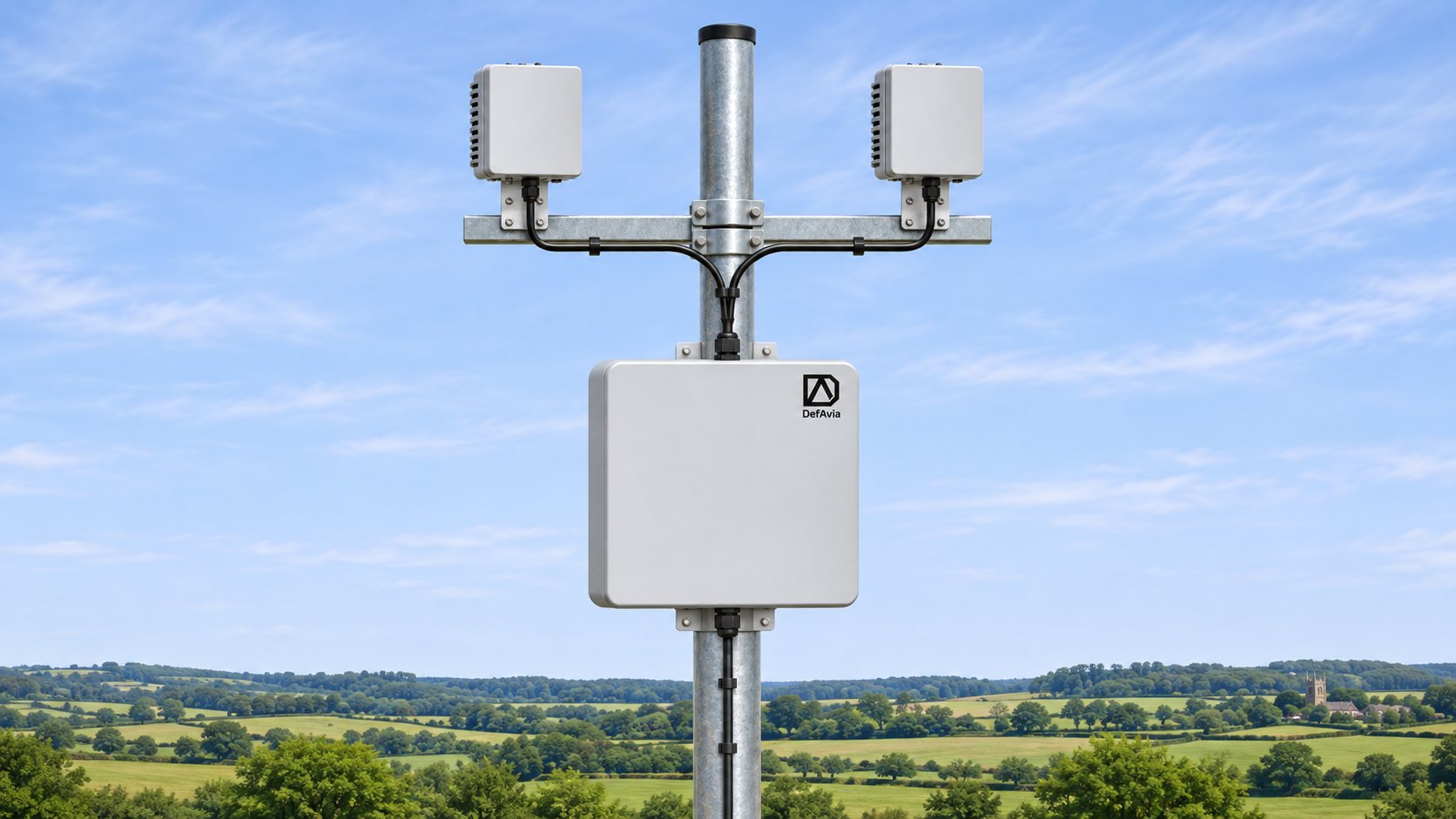
The DSR-200 is a solid-state staring radar for long-range airspace surveillance, from drones a few kilometres out to aircraft beyond 150 km. It watches a 60° × 60° sector without pause, reporting range, bearing, height and speed for every target, with nothing that rotates or wears out. Networked MIMO links several units into one distributed aperture.
DSR-200 · Capabilities
Because the beam never leaves the sector, the receiver integrates for seconds rather than milliseconds: 10 and 20 s windows for steady aircraft-class targets, 0.1 to 3 s for drones, all processed at once.
Range, azimuth, elevation and radial velocity for every detection, bearing accuracy of about 0.5°, with ADS-B overlay for reference and SAPIENT output for the command system.
In S-band, rain and light foliage cost far less than at X- or Ku-band, and four high-gain panels give the aperture for distance: 146 km on a large aircraft, 37 km on a 1 m² tactical UAS, 5.5 km on a 0.01 m² drone.
Units on a site share their transmit codes and receive data over fibre or IP, so every receiver hears every transmitter: a distributed aperture for sharper bearings, longer reach and resilience to the loss of any one unit. Six units give all-round cover.
Use cases Borders and coastlines · airfields and airspace monitoring · critical infrastructure · gap-filling for national radar networks · research
DSR-200 · Detection range
Measured Airliner tracked at 279 km in field trials (40 W), 1 s updates, confirmed against ADS-B.
| Target class | RCS | 0.1 s | 1 s | 3 s | 10 s ² | 1 s look, 0 to 120 km |
|---|---|---|---|---|---|---|
| Class 1a · Nano | 0.001 m² | 1.7 | 3.1 | 4.0 | 5.4 | |
| Class 1b · Micro | 0.005 m² | 2.6 | 4.8 | 5.9 | 8.0 | |
| Small quadcopter | 0.01 m² | 3.1 | 5.5 | 7.4 | 10.0 | |
| Class 1c · Mini | 0.1 m² | 7.2 | 12.7 | 17.0 | 23.0 | |
| Class 1d · Small | 0.5 m² | 12.5 | 22.1 | 29.0 | 39.2 | |
| Class 2 · Tactical UAS | 1 m² | 15.7 | 27.8 | 37.0 | 49.9 | |
| Light aircraft | 5 m² | 26.5 | 46.8 | 62.1 | 84.1 | |
| Large aircraft | 20 m² | 62 | 110 | 146 | 198 |
Range in km by look time, boresight, 2 × 50 W; 10 and 20 s looks on steady aircraft-class targets. ≈ 93 % of this at ±10°, ≈ 80 % at ±30°. ² 10 and 20 s looks use range-walk and Doppler compensation. Preliminary; specifications subject to change.
DSR-200 · Technical data
Detection range: Pd 0.5, Pfa 10⁻⁶ per cell, Swerling 1, coherent look, thermal noise floor. ¹ A radiolocation licence is required at these power levels (UK: Ofcom). Specifications subject to change without notice.
Ask for the datasheet or a demonstration at your site.